Platform comparison
| Platform | YES odds | NO odds | Fee | KYC | Settlement | |
|---|---|---|---|---|---|---|
Polymarket (via Polymarket Bot UK) Pick polygram.ink (preferred broker) |
25% | 75% | 0% (USDC on-chain) | No-KYC up to $1,500 | USDC, auto via UMA oracle | Place a position → |
Polymarket (direct) polymarket.com |
25% | 75% | 0% | Geo-blocked in US/UK/EU | USDC, on-chain | Place a position → |
Kalshi kalshi.com |
— | — | Up to 7% per trade | US-only, KYC required | USD | Place a position → |
Betfair Exchange betfair.com |
— | — | 2-5% commission | Full KYC from first trade | GBP / EUR | Place a position → |
Manifold Markets manifold.markets |
— | — | Play-money (mana) | None — play-money | Mana (no cash-out) | Place a position → |
Outcome probabilities
Current market-implied probability for each outcome, from the live order book.
| Outcome | Probability |
|---|---|
| Somaliland | 25% |
| Qatar | 12% |
| Syria | 12% |
| Jordan | 11% |
| Kuwait | 10% |
| Lebanon | 10% |
| Saudi Arabia | 9% |
| Egypt | 8% |
| Azerbaijan | 7% |
| Pakistan | 6% |
| Turkey | 5% |
| Oman | 5% |
Market context
The real-world event is a **formal normalisation agreement** with Israel being signed and publicly tied to the Abraham Accords framework before the settlement deadline. At a crowd-implied **6%** chance, the market is pricing this as a low-probability diplomatic breakthrough rather than a routine policy event.
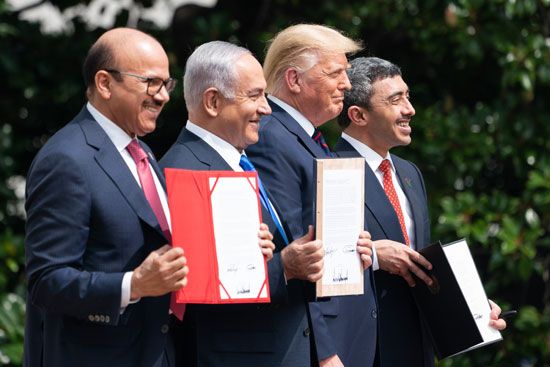
The historical pattern argues for caution with overconfident pricing. The Abraham Accords have been expanded only intermittently: the original 2020 wave brought the UAE and Bahrain in first, then Morocco and Sudan followed through separate agreements, showing that each accession has required its own bilateral political deal and public signature rather than a broad regional announcement[5][8][9]. More recent reporting says Kazakhstan has already been announced as joining, which matters because it shows the framework is still active, but also because it highlights how rare formal additions remain after the initial rush[1][4][6]. For a programme that tracks this market mechanically, the key distinction is not rhetoric about “joining” but whether a signed, government-stated accord explicitly lands inside the Abraham Accords umbrella.
The main catalysts to watch are high-level White House or foreign-ministry announcements, scheduled visits, and any statement that names both the country and the accord framework in formal terms. Recent coverage suggests US diplomacy is still trying to widen the map, with Trump publicly pushing for further entries and linking broader regional talks to the accords, while other reporting says near-term expansion is still considered unlikely[2][4][7]. For conditional-order logic, the useful triggers are not rumours or exploratory talks; they are documentable steps such as an official signing ceremony, joint communiqués, or explicit government confirmation that the agreement is part of the Abraham Accords or its continuation.
Methodology
This page is a comparison snapshot: one live quote, four reference venues with their key attributes, and a single execution path — every trade button routes to Polymarket Bot UK, which mirrors the Polymarket order book directly.
Resolution & payout
Settlement runs on-chain. Polymarket's contract logic separates YES and NO shares as conditional tokens; at resolution the winning share lifts to $1.00 and the losing one to $0. The outcome input comes from the UMA Optimistic Oracle, which secures against bad resolution with a bond + dispute window.
Once finalised, the smart contract pays USDC to the holders' wallets within minutes — no withdrawal fees beyond Polygon network gas. Kalshi settles in USD via CFTC clearance, Betfair in account currency net of commission, Manifold in play-money mana with no cash-out.
FAQ
- How does resolution work?
- Through the UMA Optimistic Oracle on Polygon: a proposer submits the outcome, a two-hour challenge window opens, and USDC payouts settle automatically once the result is final.
- What's the difference between YES and NO shares?
- A YES share pays $1.00 if the event happens, $0 otherwise. A NO share pays $1.00 if the event doesn't happen. The market price between 0¢ and 100¢ is the implied probability.
- What does Polymarket cost to trade?
- Polymarket itself charges 0% — the only cost is the Polygon network fee, typically under $0.01 per transaction. Off-chain venues like Kalshi or Betfair charge 2-7% commission.
- Do I need to KYC for this market?
- On Polymarket directly, no — it's wallet-based. Intermediary brokers like Polymarket Bot UK trigger KYC only above $1,500 of lifetime trading volume; under that you trade pseudonymously with a single wallet address.
- How reliable are the quoted odds?
- The YES/NO percentages are the live mid-prices of the Polymarket order book. On deep markets they move every few seconds; on thinner ones you'll see short plateaus.
%22%2F%3E%3Cpath%20d%3D%22M%206%2066%20A%2026%2026%200%200%201%2058%2066%22%20fill%3D%22%23E6B98D%22%20opacity%3D%220.9%22%2F%3E%3Ccircle%20cx%3D%2232%22%20cy%3D%2226%22%20r%3D%2222%22%20fill%3D%22%23F5CBA7%22%2F%3E%3Crect%20x%3D%2214%22%20y%3D%224%22%20width%3D%2236%22%20height%3D%228%22%20rx%3D%224%22%20fill%3D%22%230ea5e9%22%2F%3E%3C%2Fsvg%3E) and
and%22%2F%3E%3Cpath%20d%3D%22M%206%2066%20A%2026%2026%200%200%201%2058%2066%22%20fill%3D%22%23E6B98D%22%20opacity%3D%220.9%22%2F%3E%3Ccircle%20cx%3D%2232%22%20cy%3D%2226%22%20r%3D%2222%22%20fill%3D%22%23F5CBA7%22%2F%3E%3Cpolygon%20points%3D%2216%2C18%2020%2C4%2024%2C18%22%20fill%3D%22%230ea5e9%22%2F%3E%3Cpolygon%20points%3D%2224%2C18%2028%2C3%2032%2C18%22%20fill%3D%22%230ea5e9%22%2F%3E%3Cpolygon%20points%3D%2232%2C18%2036%2C3%2040%2C18%22%20fill%3D%22%230ea5e9%22%2F%3E%3Cpolygon%20points%3D%2240%2C18%2044%2C4%2048%2C18%22%20fill%3D%22%230ea5e9%22%2F%3E%3C%2Fsvg%3E)
Trade Which country will join Abraham Accords before 2027? on Polymarket Bot UK
Live order book, 0% fees, USDC settlement in seconds.
Open live market →